
Dermoid Cysts and Fertility: When Should They Be Removed?
November 02, 2026Dermoid Cysts and Fertility: What Every Woman Should Know
Finding an ovarian cyst during an ultrasound can be worrying, especially when you are trying to conceive. If you have been told that you have a dermoid cyst, one of the first questions is often: Will this affect my fertility, and do I need surgery?
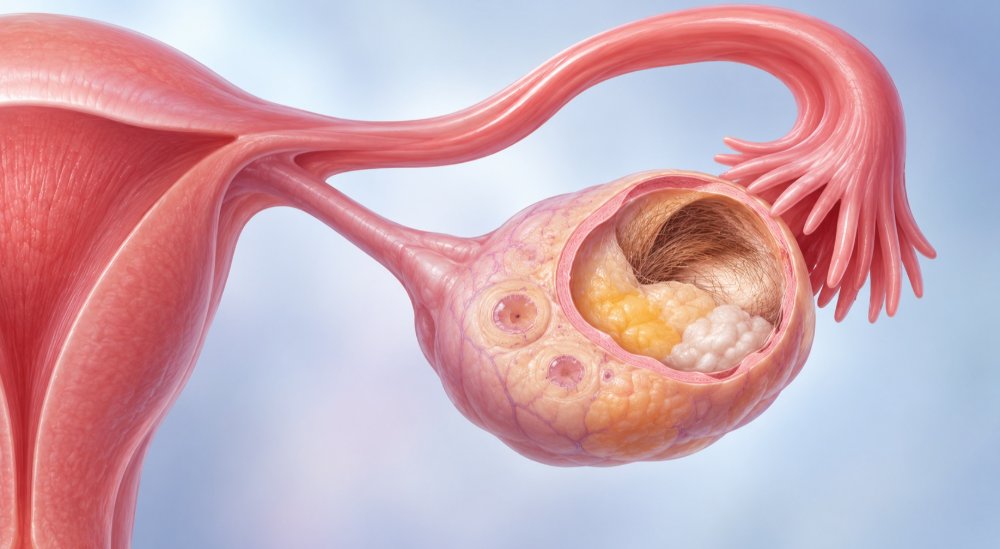
The good news is that ovarian dermoid cysts are usually benign. A dermoid cyst, also called a mature cystic teratoma, is a benign ovarian tumor that can contain different types of tissue, including fat, skin and hair. Many dermoid cysts cause no symptoms and are discovered incidentally during an ultrasound.
However, management is not the same for every woman. The size and appearance of the cyst, symptoms, age, ovarian reserve and, importantly, reproductive plans all need to be considered.
For a woman who is planning a pregnancy or considering IVF, the key question is not simply whether a dermoid cyst can be removed. It is whether removing it now provides enough benefit to justify operating on an ovary that is otherwise functioning normally.
What is an ovarian dermoid cyst?
A dermoid cyst is a type of benign ovarian tumor originating from cells that can develop into different tissues of the body. Because of this, the cyst may contain fat, hair or other tissue.
Dermoid cysts are among the common benign ovarian tumors seen during the reproductive years. Most are not cancerous. Malignant transformation is possible but rare.
Many women have no symptoms at all. Others may experience pelvic or abdominal discomfort, pressure, pain during certain activities or other symptoms related to the size or position of the cyst.
A particularly important complication of a larger ovarian cyst is ovarian torsion, when the ovary twists around its supporting tissues and its blood supply can become compromised. Sudden, severe pelvic pain, particularly when accompanied by nausea or vomiting, requires urgent medical assessment.
Does a dermoid cyst affect fertility?
Not necessarily.
The presence of a dermoid cyst does not automatically mean that a woman will have difficulty becoming pregnant. In one retrospective study of women undergoing IVF, ovarian reserve, implantation and IVF outcomes were not lower in women with an ovarian dermoid cyst compared with women without one. The study also found no significant difference in IVF outcomes between women whose dermoid cyst had been surgically removed and those whose cyst was left in place.
This is an important point because the cyst itself and the surgery used to remove it are two different considerations.
A dermoid cyst may be relatively harmless from a fertility perspective, while surgery on the ovary can potentially affect ovarian tissue.
Does dermoid cyst surgery reduce ovarian reserve?
This is one of the most important questions for women who are trying to conceive.
Ovarian cystectomy means removing the cyst while attempting to preserve the ovary. Even when surgery is technically successful and the ovary is preserved, some ovarian tissue may be affected.
Studies evaluating ovarian cystectomy have reported reductions in markers of ovarian reserve, including anti-Müllerian hormone, after surgery for benign ovarian cysts. The degree of effect varies between studies and depends on several factors, including the type and size of the cyst, the surgical technique and how much normal ovarian tissue is affected.
More recent data have also demonstrated a reduction in anti-Müllerian hormone following laparoscopic removal of dermoid cysts. This does not mean that every woman will experience a clinically significant loss of fertility, but it reinforces the importance of avoiding unnecessary ovarian surgery.
For this reason, the decision to operate should be individualized rather than based on the diagnosis of a dermoid cyst alone.
When does a dermoid cyst need surgery?
There is no single size that automatically means that every dermoid cyst should be removed.
Surgery may be considered when:
- The cyst is causing significant or persistent symptoms.
- The cyst is large or increasing in size.
- There are ultrasound features that require further evaluation.
- There is concern about complications such as torsion.
- There is uncertainty about the diagnosis.
- The overall clinical situation makes removal preferable to continued observation.
RCOG guidance notes that mature cystic teratomas can grow over time and that surgical management may therefore be appropriate in selected women, while also emphasizing assessment of the ovarian mass and individualized management.
The decision should also take into account the woman's age, ovarian reserve and reproductive plans.
Should a dermoid cyst be removed before IVF?
Not automatically.
This is particularly important because many women are referred for surgery simply because they are preparing for IVF.
If a dermoid cyst is asymptomatic, has reassuring ultrasound characteristics and is not interfering with ovarian access or treatment, immediate surgery may not always be necessary.
A study specifically examining women undergoing IVF found that the presence of a dermoid cyst did not reduce ovarian reserve or IVF outcomes and concluded that, when surgery is indicated, it may be possible to postpone it until after family-building goals have been achieved.
However, this does not mean that every woman with a dermoid cyst should proceed directly to IVF without further evaluation.
The decision depends on the individual situation. A large cyst, significant symptoms, suspicious imaging, previous torsion, difficult ovarian access or other clinical factors may change the recommendation.
This is where coordination between a gynecologic surgeon and a reproductive medicine specialist can be particularly valuable.
What happens during dermoid cyst surgery?
When surgery is indicated and the cyst appears benign, minimally invasive surgery, usually laparoscopy, is commonly considered. Laparoscopy generally involves smaller incisions and faster recovery than open abdominal surgery.
The preferred fertility-sparing approach is usually to remove the cyst while preserving as much healthy ovarian tissue as possible.
This requires careful surgical technique. Avoiding unnecessary damage to the ovarian cortex and minimizing the use of thermal energy when possible are important principles when ovarian reserve matters.
The surgeon also needs to consider the possibility of cyst rupture and spillage during removal, as dermoid contents can cause inflammation within the abdominal cavity.
In selected women, ovarian-sparing surgery is therefore preferable to removing the entire ovary. However, the exact procedure depends on the size and characteristics of the cyst, the amount of remaining ovarian tissue and the clinical circumstances.
What if I have a dermoid cyst and low ovarian reserve?
This situation requires particular care.
If ovarian reserve is already reduced, removing an ovarian cyst may have a greater practical significance because there is less ovarian reserve to preserve.
Before surgery, it may therefore be appropriate to assess ovarian reserve and discuss reproductive plans. Depending on the woman's age, ovarian reserve and urgency of fertility treatment, an individualized fertility-preservation or IVF strategy may sometimes be considered before surgery.
There is no universal sequence that applies to every patient. In some women, surgery should come first. In others, proceeding with fertility treatment before surgery may be more appropriate.
The important point is to make the decision before operating, rather than discovering afterward that the timing of treatment could have been different.
Can I get pregnant naturally with a dermoid cyst?
Yes.
Many women with dermoid cysts conceive naturally, particularly when the cyst is small, asymptomatic and the ovaries are otherwise functioning normally.
A dermoid cyst is not itself equivalent to infertility.
If pregnancy does not occur, however, the full fertility picture should be assessed. Age, ovulation, ovarian reserve, fallopian tubes, sperm factors and other gynecological conditions may be much more relevant to fertility than the presence of the dermoid cyst itself.
Dermoid cysts and fertility: the key message
A dermoid cyst can look alarming on an ultrasound, but the diagnosis alone does not mean that fertility will be affected.
For women planning pregnancy, the most important question is whether the cyst itself presents a meaningful risk or whether surgery could introduce an avoidable risk to ovarian tissue.
The best approach is therefore individualized.
A fertility-focused assessment should consider:
- The size and ultrasound appearance of the cyst.
- Whether the cyst is causing symptoms.
- The risk of torsion or other complications.
- The woman's age and reproductive plans.
- Ovarian reserve.
- Whether IVF or other fertility treatment is planned.
- Whether surgery could be safely postponed.
- How ovarian tissue can best be preserved if surgery is necessary.
For women considering fertility treatment in Lebanon, these decisions are best made with a reproductive medicine specialist who can look at the ovarian cyst in the context of the entire fertility plan.
Frequently Asked Questions
Can a dermoid cyst cause infertility?
A dermoid cyst does not automatically cause infertility. Available IVF data suggest that the presence of a dermoid cyst does not necessarily reduce ovarian reserve or IVF success. Other fertility factors should be assessed individually.
Does every dermoid cyst need to be removed?
No. Management depends on symptoms, size, growth, ultrasound appearance, complications and the woman's reproductive plans. Some cysts can be monitored, while others may require surgery.
Can dermoid cyst surgery affect ovarian reserve?
Yes. Ovarian cystectomy can reduce markers of ovarian reserve in some women. This is why ovarian-sparing surgical techniques and careful consideration of whether surgery is necessary are important.
Should I remove a dermoid cyst before IVF?
Not necessarily. Some women can proceed with IVF without removing an asymptomatic, reassuring dermoid cyst. The decision depends on factors such as cyst size, ovarian access, symptoms, imaging and ovarian reserve.
Can I become pregnant naturally with a dermoid cyst?
Yes. Many women with dermoid cysts conceive naturally. A dermoid cyst should not automatically be considered the cause of infertility.
When should I seek urgent medical attention?
Sudden or severe pelvic or abdominal pain, especially with nausea or vomiting, may indicate ovarian torsion or another acute complication and requires urgent medical evaluation.
Conclusion
A dermoid cyst is usually a benign ovarian finding, and its presence does not automatically threaten fertility. The more important question is whether treatment is necessary and, if surgery is recommended, how to protect as much healthy ovarian tissue as possible.
For women who are planning pregnancy or IVF, the decision to operate should take ovarian reserve and reproductive goals into account. In selected women, monitoring or postponing surgery may be reasonable; in others, surgery may be the safer option.
The right decision is an individualized one.
References
- Royal College of Obstetricians and Gynaecologists. Ovarian Cysts Before the Menopause.
- American College of Obstetricians and Gynecologists. Ovarian Cysts.
- Royal College of Obstetricians and Gynaecologists. Management of Suspected Ovarian Masses in Premenopausal Women.
- Conservative treatment versus surgical excision of ovarian dermoid cysts: Impact on ovarian stimulation and IVF cycle success.
- Impact of Cystectomy on Ovarian Reserve: Review of the Literature.
- The impact of excision of benign nonendometriotic ovarian cysts on ovarian reserve: a systematic review.
- Effects of ovarian cyst types on ovarian reserve after three-dimensional laparoscopic cystectomy.