
HSG vs HyCoSy: Which Test Is Better for Checking Fallopian Tubes?
November 09, 2026HSG vs HyCoSy: What Is the Difference and Which Test Is Right for You?
When a woman is being evaluated for infertility, one important question is whether the fallopian tubes are open.
The fallopian tubes are where the egg and sperm normally meet. If a tube is blocked or significantly damaged, natural conception may become more difficult.
Two established tests are commonly used to assess whether the tubes are open:
- Hysterosalpingography (HSG)
- Hysterosalpingo-contrast sonography (HyCoSy)
Both tests assess tubal patency, but they use different imaging technologies.
So, which one is better?
The answer is not simply one or the other.
Current international guidance considers both HSG and HyCoSy valid methods for evaluating tubal patency. ESHRE states that they have comparable diagnostic capacity, while the World Health Organization recommends either test when tubal disease is suspected, with the choice taking into account feasibility, trained personnel and other patient-specific factors.
The updated 2026 AIUM practice parameter also states that properly performed HyCoSy can have accuracy essentially equivalent to HSG and laparoscopic chromopertubation.
The most useful question, therefore, is not simply "Which test is better?"
It is:
"Which test will give my doctor the most reliable information for my particular situation?"
What Is an HSG?
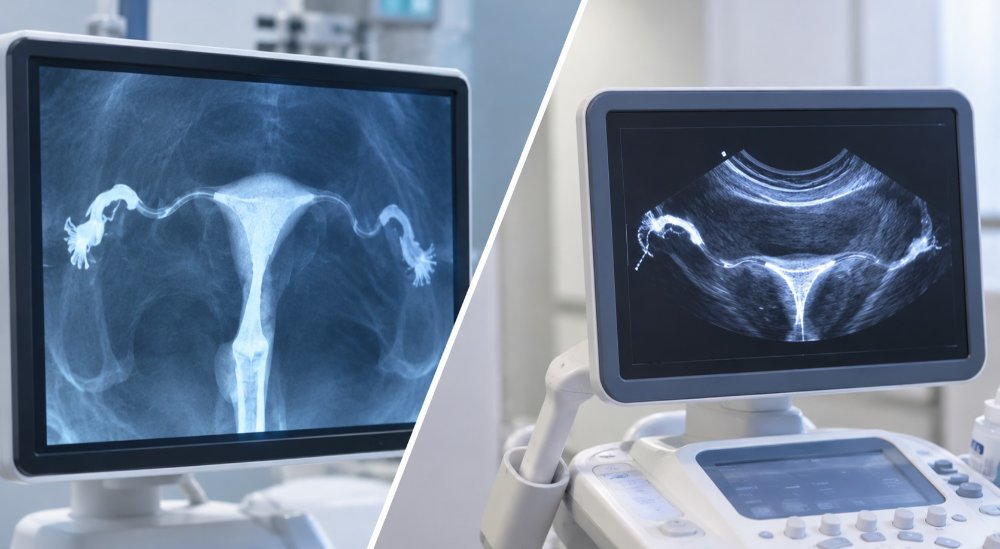
HSG stands for hysterosalpingography.
It is an X-ray examination in which contrast material is introduced through the cervix into the uterus.
As the contrast fills the uterine cavity and passes through the fallopian tubes, X-ray images are taken.
If the contrast passes through a tube and spills into the pelvic cavity, the tube is considered patent.
HSG can therefore provide information about:
- The shape and outline of the uterine cavity
- Whether contrast passes through the fallopian tubes
- Whether a tube appears obstructed
- The location of an apparent tubal obstruction in some cases
HSG has been used for many years and remains an established method of evaluating tubal patency.
What Is HyCoSy?
HyCoSy stands for hysterosalpingo-contrast sonography.
Instead of using X-rays, HyCoSy uses ultrasound to observe the passage of contrast through the fallopian tubes.
A thin catheter is introduced through the cervix, and contrast is instilled into the uterine cavity while the physician observes the uterus and tubes using ultrasound.
When contrast can be seen passing through a tube and reaching the pelvis, this indicates tubal patency.
One important advantage of HyCoSy is that the physician can observe the process in real time using ultrasound.
The 2026 AIUM practice parameter describes HyCoSy as an ultrasound evaluation of tubal patency and states that, when properly performed, its accuracy can be essentially equivalent to HSG and laparoscopic chromopertubation.
HSG vs HyCoSy: What Are the Main Differences?
HSG
Imaging method: X-ray
Ionizing radiation: Yes
Contrast: Radiographic contrast
Assesses tubal patency: Yes
Assesses uterine cavity: Yes
Real-time ultrasound visualization: No
Operator expertise: Important
Availability: Depends on local services
Can cause cramping: Yes
Pregnancy must be excluded: Yes
HyCoSy
Imaging method: Ultrasound
Ionizing radiation: No
Contrast: Ultrasound-visible contrast
Assesses tubal patency: Yes
Assesses uterine cavity: Yes
Real-time ultrasound visualization: Yes
Operator expertise: Particularly important
Availability: Depends on trained expertise and equipment
Can cause cramping: Yes
Pregnancy must be excluded: Yes
Is HSG More Accurate Than HyCoSy?
This is one of the most common questions patients ask.
The current evidence does not support a simple statement that HSG is always more accurate.
ESHRE considers HSG and HyCoSy valid tests for tubal patency and states that their diagnostic capacity is comparable.
The 2026 AIUM practice parameter similarly states that properly performed HyCoSy can have accuracy essentially equivalent to HSG and laparoscopic chromopertubation.
However, the quality of the examination matters.
HyCoSy is particularly dependent on the skill and experience of the physician performing and interpreting the ultrasound examination.
This means that a high-quality HyCoSy performed by an experienced specialist can provide excellent diagnostic information, while a technically difficult examination may be less conclusive.
The same principle applies to HSG: the technique, image quality and interpretation all matter.
So rather than asking which technology is inherently more accurate, it is often more useful to ask whether the test is being performed by an experienced team using an appropriate technique.
Does HyCoSy Have the Advantage of No Radiation?
Yes.
HyCoSy uses ultrasound and therefore does not expose the patient to ionizing radiation.
This can be an attractive feature for some patients.
HSG, on the other hand, uses X-rays. The radiation exposure from a properly performed HSG is generally limited, but it is still an X-ray examination.
For some patients, avoiding radiation may be an important consideration. For others, the availability and expertise of the local service may be more relevant.
Which Test Is More Painful?
This question is much harder to answer.
Both HSG and HyCoSy involve passing a catheter through the cervix and introducing fluid or contrast into the uterine cavity.
Therefore, both can cause cramping or discomfort.
Some women describe the sensation as similar to menstrual cramps. Others may experience stronger, short-lived discomfort.
Pain can be influenced by:
- Cervical sensitivity
- Uterine contractions
- Anxiety and anticipation
- The technique used
- The type and volume of contrast
- The experience of the physician
ESHRE's review of the available evidence found no clear basis for assuming that one type of HyCoSy contrast consistently produces less pain than another.
Most importantly, individual experiences vary.
It is therefore better not to promise a patient that either HSG or HyCoSy will be painless.
Is HyCoSy Safer Than HSG?
Both procedures are generally considered safe when performed appropriately.
HyCoSy has the specific advantage of avoiding ionizing radiation.
However, "safer" is not the only factor that should determine the choice.
The patient's medical history, possible allergy to contrast material, pelvic pathology, the expertise of the physician and the quality of the available service all matter.
The WHO specifically recommends considering feasibility, availability of trained healthcare providers and potential allergy when selecting between HSG and HyCoSy.
As with any procedure involving the uterus, infection should be considered, and neither examination should be performed when pregnancy is possible.
Can HSG or HyCoSy Give a False Impression of Tubal Blockage?
Yes.
This is an extremely important point.
Sometimes a tube may appear blocked even though it is not permanently obstructed.
One possible reason is tubal spasm.
This is particularly relevant when an apparent blockage occurs close to the uterus.
The 2026 AIUM HyCoSy practice parameter specifically notes that tubal spasm can produce an appearance similar to lack of tubal patency.
Technical factors can also make interpretation more difficult.
Therefore, an unexpected result does not always mean that the tube is permanently blocked.
Depending on the circumstances, the fertility specialist may recommend further assessment or interpret the finding together with the patient's history and other investigations.
When Is HSG Usually Used?
Current NICE guidance recommends HSG as a reliable test to screen for tubal occlusion in women without known pelvic comorbidities such as pelvic inflammatory disease, previous ectopic pregnancy or endometriosis.
NICE also recognizes HyCoSy as an effective alternative when appropriate expertise is available.
HSG may therefore be particularly appropriate when:
- It is readily available
- The local team has extensive experience with HSG
- X-ray assessment is appropriate
- There is a need for a traditional radiographic assessment of tubal passage
The choice should always be individualized.
When Is HyCoSy Usually Used?
HyCoSy may be particularly attractive when:
- Avoiding ionizing radiation is desirable
- Experienced ultrasound expertise is available
- Real-time visualization is useful
- The physician wants to assess the uterus and pelvis during the same ultrasound-based examination
The updated AIUM practice parameter emphasizes the importance of appropriate training and expertise for physicians performing and interpreting HyCoSy.
This is important because HyCoSy is not simply a standard ultrasound examination. Proper assessment of tubal passage requires specific expertise.
What About Women With a Higher Risk of Tubal Disease?
The choice of test may be different when there is a history suggesting pelvic or tubal disease.
Examples include:
- Previous pelvic inflammatory disease
- Previous ectopic pregnancy
- Previous pelvic or abdominal surgery
- Known or suspected endometriosis
- Previous tubal surgery
In these situations, the question may not simply be whether the tubes are open.
The physician may also need to know whether there is significant pelvic disease, adhesions or other pathology.
For women with suspected pelvic comorbidities, NICE recommends laparoscopy with dye because it can assess the tubes and other pelvic pathology at the same time.
This is an important distinction: HSG and HyCoSy are primarily tests of tubal patency; they do not provide the same information as directly inspecting the pelvis with laparoscopy.
Can These Tests Assess the Uterus Too?
Yes, both can provide information about the uterine cavity.
However, neither HSG nor HyCoSy replaces every other form of uterine assessment.
A transvaginal ultrasound may be used to assess the uterus and ovaries.
If there is a specific concern about the endometrial cavity, other examinations such as saline infusion sonography or hysteroscopy may be more appropriate.
The 2026 AIUM guidance emphasizes that additional studies may sometimes be necessary for a complete diagnosis.
The right test therefore depends on the clinical question.
What Happens If a Tube Appears Blocked?
The result needs to be interpreted carefully.
If one tube appears blocked and the other appears healthy, natural conception may still be possible.
If both tubes appear blocked, the physician may first consider:
- Where the suspected blockage is located
- Whether the finding is convincing
- Whether tubal spasm could explain the appearance
- The patient's medical and reproductive history
- Whether additional testing is appropriate
If significant bilateral tubal disease is confirmed, IVF may become an important treatment option because IVF bypasses the fallopian tubes.
A hydrosalpinx is a separate and particularly important tubal condition because it can influence fertility treatment planning and may require specific management.
Can HSG or HyCoSy Increase the Chance of Pregnancy?
The primary purpose of both tests is diagnostic.
However, there is evidence that tubal flushing may be associated with increased pregnancy rates in some circumstances, particularly with certain types of contrast used during HSG.
This does not mean that HSG or HyCoSy should be considered a fertility treatment in itself.
The evidence depends on the type of contrast, the patient population and the clinical circumstances.
The diagnostic role of the examination should therefore remain distinct from any possible fertility benefit associated with tubal flushing.
HSG vs HyCoSy: Which One Should You Have?
There is no universal answer.
Your fertility specialist may consider:
- Your age and reproductive history
- Previous pelvic infections
- Previous ectopic pregnancy
- Previous pelvic surgery
- Suspected endometriosis
- Previous imaging results
- Whether natural conception or insemination is being considered
- Whether IVF is planned
- Availability of experienced HSG or HyCoSy operators
- Relevant allergies or medical conditions
- Whether additional pelvic assessment is needed
This is why a fertility test should not be selected simply because one sounds newer or more comfortable.
The goal is to choose the examination that provides reliable and clinically useful information for that particular patient.
HSG vs HyCoSy: The Bottom Line
HSG and HyCoSy are both established methods of assessing fallopian tube patency.
HSG uses X-rays and radiographic contrast.
HyCoSy uses ultrasound and contrast that can be visualized during the examination.
HyCoSy has the advantage of avoiding ionizing radiation and allows real-time ultrasound assessment.
HSG remains a well-established and widely used method for assessing tubal patency.
According to ESHRE, their diagnostic capacity is comparable, while WHO recommends either method when tubal disease is suspected, depending on feasibility, expertise and patient-specific considerations.
So there is no universal winner.
The most important factors are the right test for the right patient, performed by an experienced team and interpreted in the context of the complete fertility evaluation.
At Azoury IVF Clinic, the purpose of tubal testing is not simply to label a tube "open" or "blocked." The goal is to understand what the finding means for the patient's fertility and how it should influence the treatment plan.
Frequently Asked Questions
1. Is HSG better than HyCoSy?
Not universally. Current evidence and international guidelines consider both valid methods for assessing tubal patency. The choice depends on the patient's situation, available expertise and other clinical factors.
2. Is HyCoSy less painful than HSG?
Both can cause cramping and discomfort. Individual experiences vary, and there is not enough evidence to promise that one method will always be more comfortable.
3. Does HyCoSy use radiation?
No. HyCoSy uses ultrasound and does not involve ionizing radiation.
4. Can HyCoSy replace HSG?
Yes, in appropriate patients and where suitable expertise is available, HyCoSy can be an effective alternative to HSG for evaluating tubal patency.
5. What if HSG or HyCoSy shows that my tube is blocked?
A suspected blockage, particularly close to the uterus, may sometimes require further evaluation because tubal spasm or technical factors can mimic obstruction. Treatment depends on whether one or both tubes are affected and on the overall fertility picture.
6. Do I need a tubal test if I am going to have IVF?
Not every patient undergoing IVF needs the same investigations. Because IVF bypasses the fallopian tubes, the need for tubal assessment depends on the individual clinical situation. However, identifying significant tubal disease, particularly hydrosalpinx, can still be important for treatment planning.
Conclusion
HSG and HyCoSy are two established approaches to evaluating fallopian tube patency.
HSG uses X-rays, while HyCoSy uses ultrasound. HyCoSy avoids ionizing radiation and provides real-time visualization, while HSG remains a widely established method of tubal assessment.
Neither test should automatically be considered superior for every patient.
The most appropriate choice depends on the clinical question, the patient's history, the expertise available and the quality of the examination.
If your fertility specialist recommends a tubal patency test, understanding the differences between HSG and HyCoSy can help you understand why one examination may be recommended over the other.
At Azoury IVF Clinic, every fertility investigation should have a purpose: to provide meaningful information and help create an individualized treatment plan.
References
- European Society of Human Reproduction and Embryology. Guideline on Unexplained Infertility.
- World Health Organization. Guideline for the Prevention, Diagnosis and Treatment of Infertility. 2025.
- National Institute for Health and Care Excellence. Fertility Problems: Assessment and Treatment. Updated 2026.
- American Institute of Ultrasound in Medicine. Practice Parameter for the Performance of Sonohysterography and Hysterosalpingo-Contrast-Sonography (HyCoSy), 2025 Revision. Journal of Ultrasound in Medicine. 2026;45:E30-E37.
- American Society for Reproductive Medicine. Fertility Evaluation of Infertile Women: A Committee Opinion.