
Time-Lapse Embryo Monitoring: How Technology Brings More Transparency to the IVF Laboratory
September 28, 2026IVF happens in two worlds
When people think about IVF, they often imagine the consultation, injections, egg retrieval and embryo transfer.
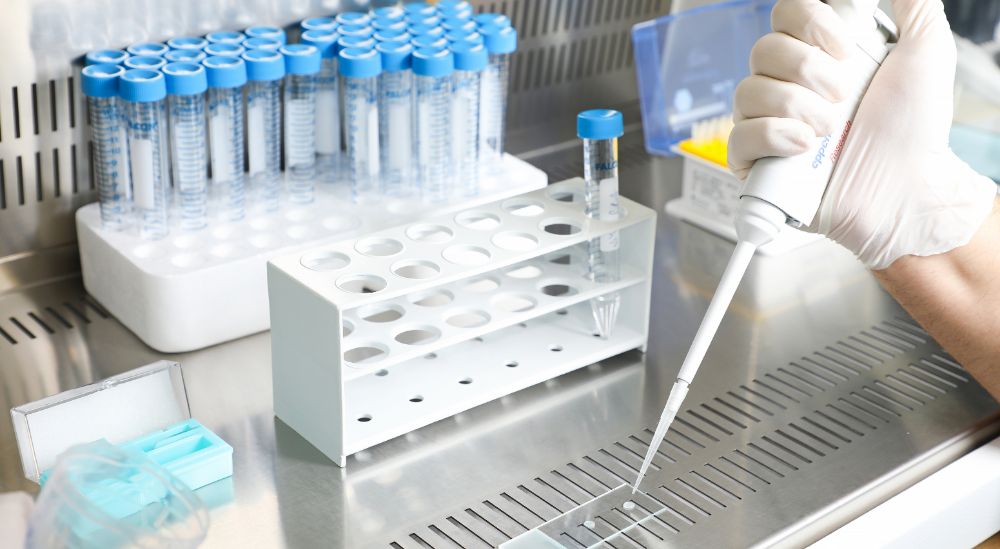
But there is another world where a crucial part of the treatment takes place: the embryology laboratory.
This is where eggs are fertilized, embryos develop, and embryologists carefully monitor their progress over several days.
For many patients, however, the laboratory can feel like a black box.
You give your eggs and sperm to the embryology team and wait for updates:
“How many fertilized?”
“How are the embryos developing?”
“How many reached the blastocyst stage?”
“What happened between Day 1 and Day 5?”
Traditionally, much of this information came from observations made at specific time points.
Time-lapse technology changes that experience.
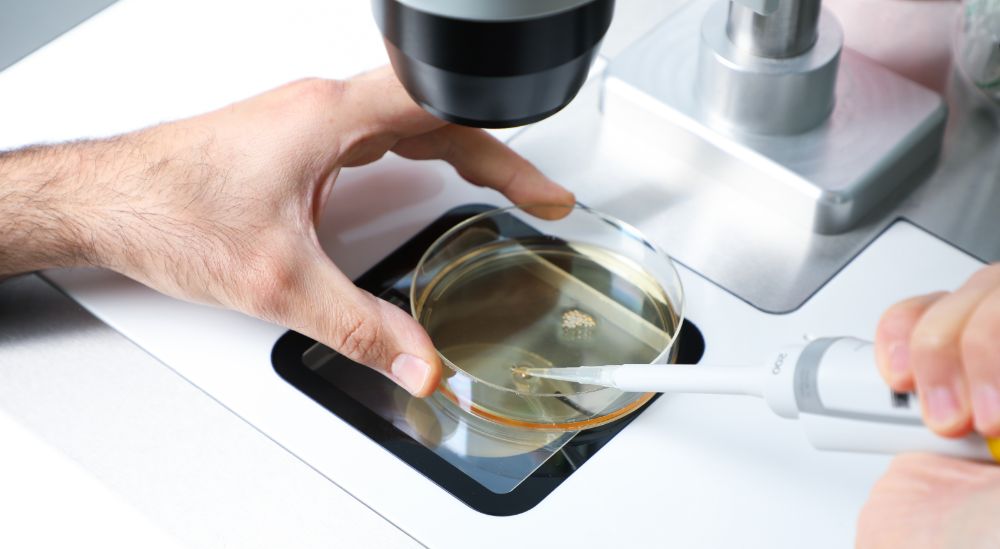
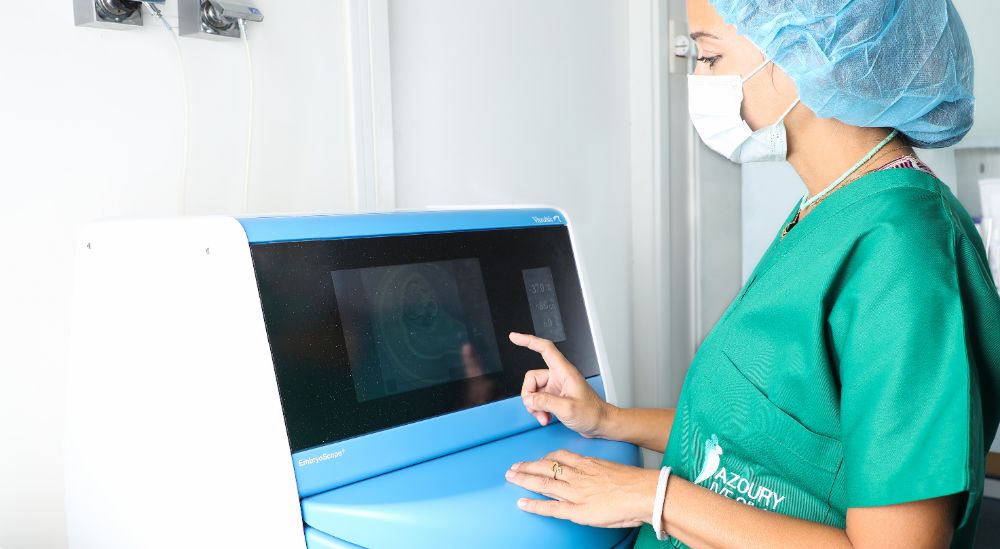
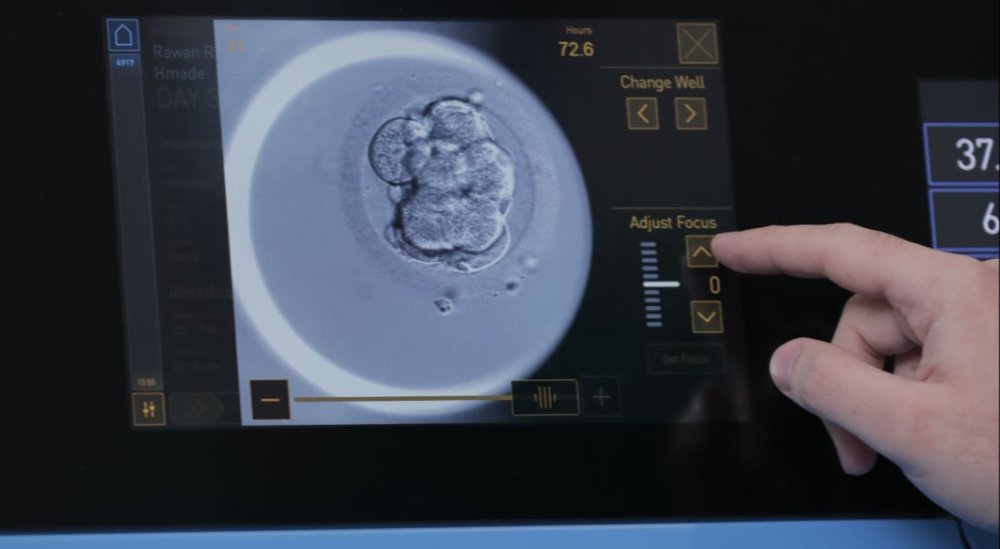
Instead of looking at an embryo only at selected moments, a time-lapse system continuously photographs the embryos while they remain inside a controlled incubator environment. This creates a visual record of their development from fertilization through the following days.
This is not simply about having better pictures.
It is about having more information, better traceability and greater transparency.
What is time-lapse embryo monitoring?
Time-lapse embryo monitoring combines an incubator with an integrated imaging system.
A camera takes repeated images of the embryos at predetermined intervals, creating a sequence that allows the embryology team to follow their development continuously.
The embryos do not need to be repeatedly removed from the incubator simply to be observed.
This means the embryologist can review important developmental events while maintaining the embryo in a controlled culture environment.
Over several days, the system can document events such as:
- Fertilization
- Cleavage and cell division
- Changes in embryo morphology
- Timing of developmental milestones
- Blastocyst formation
- Certain abnormal developmental patterns
The result is much more than a single photograph.
It is a developmental movie of the embryo.
Why does this matter for transparency?
1. Instead of snapshots, you have a story
Traditional embryo assessment provides information at particular moments.
Time-lapse allows embryologists to look back at what happened between those moments.
Two embryos may look similar when observed at a particular time point, but their developmental histories may be different.
One may have developed smoothly and progressively.
Another may have experienced unusual or abnormal developmental events that would not necessarily be visible from a single observation.
Time-lapse adds this developmental history to the information available to the embryologist.
This does not mean that the technology can predict the future with certainty. Rather, it provides more information on which to base professional assessment.
2. The embryo can be monitored without repeatedly opening the incubator
Embryos are sensitive to changes in their environment.
Traditional assessment may require embryos to be removed from their controlled incubator conditions for observation.
With time-lapse systems, imaging takes place inside the incubator.
This allows continuous monitoring while minimizing the need to repeatedly disturb the culture environment for observation. Maintaining stable culture conditions is one of the important practical advantages of time-lapse technology.
In other words:
more observation does not necessarily mean more disturbance.
3. Patients can understand what happens in the laboratory
One of the most meaningful advantages of time-lapse technology is not purely biological.
It is human.
IVF can be emotionally difficult because patients spend several days waiting for information about something they cannot see.
Time-lapse can make embryo development more tangible.
When clinics provide patients with access to embryo videos, patients can actually see the development of their embryos rather than receiving only a verbal description.
Research presented at the ESHRE Annual Meeting found that, among patients surveyed in one study, 97% felt that watching videos of their embryos added transparency regarding embryo development and the laboratory environment.
This is an important distinction:
technology does not replace communication. It can make communication more meaningful.
4. It creates a continuous visual record
Transparency is not only about showing patients what happened.
It is also about allowing the embryology team to review what happened.
Instead of relying exclusively on notes describing an embryo at selected time points, the laboratory can have a chronological visual record of its development.
This can support:
- Documentation
- Review by the embryology team
- Discussion between embryologists and physicians
- Assessment of developmental patterns
- Education and quality improvement
- Communication with patients when appropriate
This fits into the broader concept of traceability and quality management that is central to modern IVF laboratories. The updated 2026 ESHRE recommendations specifically address laboratory quality management, identification and traceability of reproductive cells and embryos, embryo culture and transfer, cryopreservation and other laboratory procedures.
5. It gives embryologists more information, not less human judgment
It is important to understand what time-lapse technology does not do.
A computer does not simply watch the embryos and decide:
“This is the embryo that will become a baby.”
Embryo development is complex.
Time-lapse provides additional information about morphology and developmental kinetics, but the interpretation remains dependent on experienced embryologists and the clinical context.
ESHRE recommendations emphasize appropriate selection of morphokinetic parameters, staff education, internal laboratory procedures and appropriate implementation of the technology.
And current evidence does not establish that time-lapse automatically increases live-birth rates in every IVF setting. A 2023 systematic review and meta-analysis of randomized trials found that evidence was low to moderate quality and did not demonstrate consistent improvements in live birth or other major clinical outcomes compared with conventional approaches.
That is exactly why transparency matters.
Good fertility care should explain both what a technology can do and what it cannot do.
Time-lapse and AI: what is the difference?
Modern time-lapse systems can generate large amounts of information about embryo development.
Artificial intelligence and machine-learning tools are increasingly being investigated to analyze embryo images and developmental patterns.
The goal is to help identify patterns that may not be obvious through conventional assessment alone.
But AI should be viewed as a decision-support tool, not as a replacement for the embryologist.
The field is evolving rapidly, and research into AI-supported embryo assessment and prediction continues.
At Azoury IVF Clinic, we believe that advanced technology should be used to support expertise, not replace it.
Does seeing an embryo video mean you can choose the embryo yourself?
No.
This is an important misconception.
Embryo selection is a medical and embryological decision based on several factors.
A beautiful-looking embryo is not necessarily genetically normal, and time-lapse imaging cannot replace genetic testing when genetic testing is clinically indicated.
Time-lapse provides additional information about development. It does not provide certainty about implantation, pregnancy or the birth of a healthy baby.
The purpose is not to turn embryo selection into a beauty contest.
It is to give the embryology team more information about the embryo's developmental journey.
Transparency is more than showing a video
True laboratory transparency is not created by a camera alone.
It requires:
Technology + traceability + experienced embryologists + quality control + clear communication.
A time-lapse system can show what happened.
A good laboratory must know how to interpret what happened.
And a good fertility clinic should be willing to explain it to the patient.
That is where technology becomes meaningful.
Why we believe patients deserve to see more
At Azoury IVF Clinic, we believe that patients should not feel that their embryos disappear behind a laboratory door for five days.
They should understand what happens to them.
They should be able to ask questions.
They should receive clear information.
And whenever appropriate, technology should help us bring the laboratory closer to the patient.
Time-lapse monitoring allows us to follow embryo development continuously and creates a visual record of this extraordinary process.
For patients, this can transform five days of waiting into five days of understanding.
Because IVF is not only about numbers.
It is about the beginning of a potential life.
And when technology allows us to make that journey more visible, understandable and transparent, it becomes much more than a piece of equipment.
It becomes part of a more open relationship between the patient, the physician and the embryology laboratory.
The bottom line
Time-lapse embryo monitoring offers an important window into the IVF laboratory.
It can:
- Continuously monitor embryo development
- Reduce the need to repeatedly remove embryos from controlled culture conditions
- Record developmental events over time
- Give embryologists additional information for assessment
- Support laboratory documentation and review
- Allow patients, when clinics provide access, to see their embryos developing
- Make the IVF laboratory more understandable and transparent
But it is important to remain scientifically honest: time-lapse is not a crystal ball.
It does not guarantee implantation, pregnancy or a healthy baby.
Its real value lies in giving embryologists more information while giving patients more visibility into a process that was once almost entirely hidden from them.
And sometimes, in IVF, knowing more about what is happening is valuable in itself.
Frequently Asked Questions
What is time-lapse embryo monitoring?
Time-lapse embryo monitoring uses an imaging system integrated into an IVF incubator to photograph embryos repeatedly during culture. This creates a continuous record of embryo development without requiring the embryos to be removed for every observation.
Does time-lapse improve IVF success rates?
The evidence remains mixed. Time-lapse can provide additional information about embryo development, but current randomized evidence has not consistently demonstrated an improvement in live-birth rates compared with conventional embryo assessment.
Can I see my embryo with time-lapse technology?
Some fertility clinics provide patients with access to embryo videos. Patient research suggests that viewing embryo development can increase patients' perception of transparency and understanding of the IVF laboratory.
Does time-lapse replace the embryologist?
No. Time-lapse provides additional information, but experienced embryologists remain essential for interpreting embryo development and integrating laboratory findings into the overall clinical picture.
Can time-lapse tell whether an embryo is genetically normal?
No. Time-lapse cannot diagnose chromosomal normality. Developmental patterns may provide information about embryo behavior, but they cannot replace genetic testing when PGT is indicated.
Is time-lapse the same as artificial intelligence?
No. Time-lapse is the technology used to continuously image and monitor embryos. Artificial intelligence may subsequently be used to analyze images or developmental data. The two technologies can work together but are not the same thing.
Why is transparency important in IVF?
IVF involves complex laboratory procedures that patients cannot directly observe. Greater transparency can help patients understand what happens to their eggs and embryos during treatment, communicate more effectively with their medical team and feel more connected to the process.
References
- ESHRE Working Group on Time-Lapse Technology. Good practice recommendations for the use of time-lapse technology. Human Reproduction Open. 2020.
- ESHRE IVF Labs Working Group. ESHRE recommendations on Good Practice in the IVF laboratory. Human Reproduction. 2026.
- The effect of embryo selection using time-lapse monitoring on IVF/ICSI outcomes: a systematic review and meta-analysis. 2023.
- Time lapse imaging: is it time to incorporate this technology into routine clinical practice? Human Reproduction.
- ESHRE Annual Meeting Abstracts. Patient experience of access to embryo development videos using time-lapse technology.